A new open access article just out in Philosophical Explorations!
“Value-deflationist self-control”
Polaris Koi
Abstract: On the standard conception of self-control, self-control entails the resolution of a motivational conflict in favour of the option ranked better, loftier, or otherwise more valuable, and behaving accordingly. Sometimes, however, we appear to use self-control under ambivalence, or against our better judgment. In this paper, I seek to eliminate the apparent paradox induced by these cases by defending and developing a value-deflationist conception of self-control. For the value-deflationist conception of self-control endorsed in this paper, self-control is that which is enacted to align one’s behaviour with intention in the face of a competing motivation. I develop the view further by showing that errant and ambivalent cases of self-control are not mere anomalies or theoretical curiosities but instead are important for understanding disruptions of agency due to motivational-executive double binds, where agents struggle both to rank options and to steer their behaviour. Adopting a value-deflationist account allows us to describe how ambivalence undermines self-control. Value-deflationism about self-control has faced a range of criticisms, such as the criticism that errant cases would turn out to be standard cases under a different description. The paper responds to these criticisms, showing that attempts to reconcile these cases with the standard conception fall short.
Author Archives: polariskoi
Podcast interview (The Academic Imperfectionist): Polaris on rethinking self-control
Polaris recently appeared on Dr. Rebecca Roache’s podcast, The Academic Imperfectionist.
In the episode, Polaris & Rebecca discuss Polaris’ work on self-control, neurodiversity, and how we culturally get self-control all wrong. Topics of discussion included Polaris’ journey into philosophy, his work-in-progress progress book “Against willpower: Self-control, agency, and society”, as well as about his work with Ronroo.
Check out the episode here! And, make sure to browse the podcast archives as well for Rebecca’s top-notch insights on how to work through procrastination, gain self-compassion, and get things done without grinding your teeth.
CFP: Agential Capacities in Context
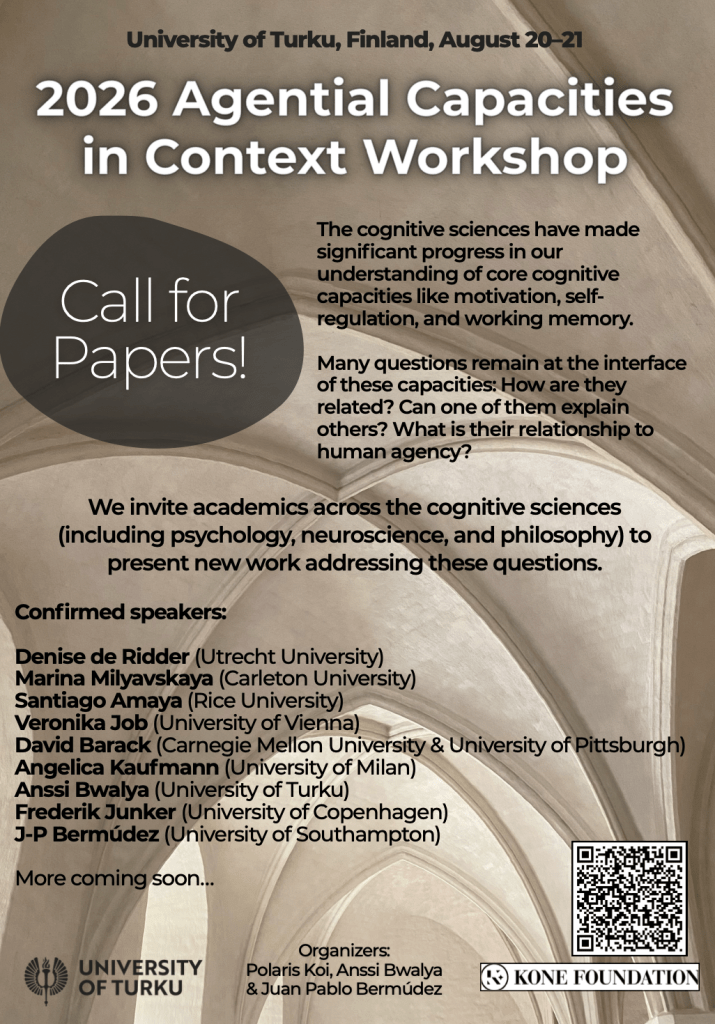
We’re excited to announce our upcoming event, Agential Capacities in Context!
We have a stellar line-up and an open call for papers for junior scholars.
Check out more information on the event’s website.
Welcoming Dr. Jussi Jylkkä to the team!
We’re excited to share the newest addition to our research group – Dr. Jussi Jylkkä!
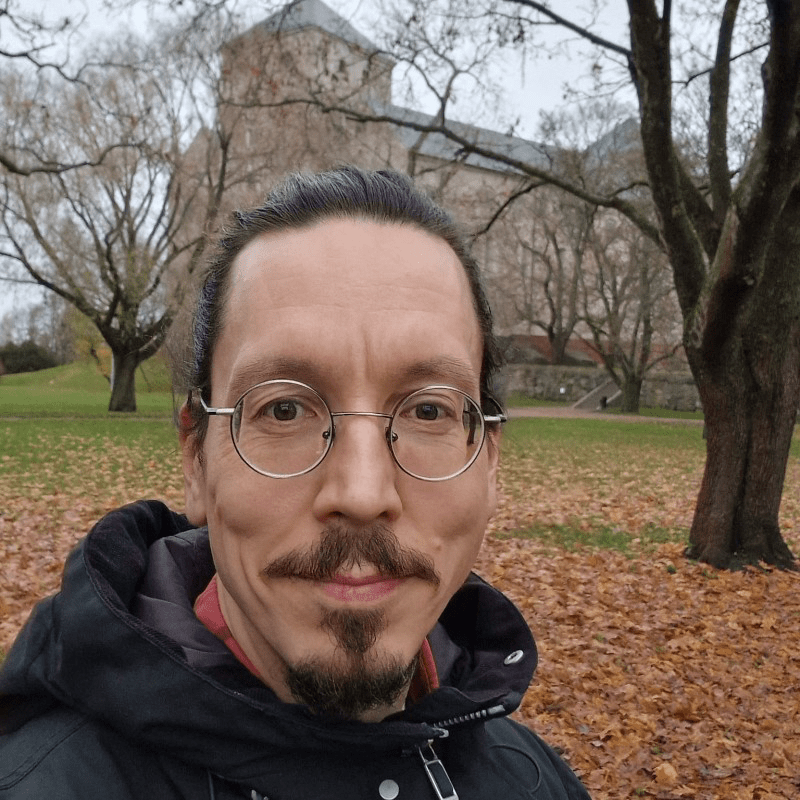
Dr. Jussi Jylkkä holds doctorates in both Philosophy and Psychology. His research interests span metacognition, executive functions, consciousness, meditation and psychedelic therapies.
Dr. Jylkkä joins the group as a senior research fellow, and his position is connected to the “Enhancing metacognition, agency and resilience in AI-mediated work” research project, which is part of the larger Transform-AI research consortium.
New article alert: Measuring self-control beliefs
Fresh off the press, a new open access article with Polaris’ postdoc Anssi Bwalya as lead author examines fixedness and malleability as a dimension of lay beliefs about self-control.
Published in Psychological Reports, this paper is part of our Agency as Experience and Capacity research project, and stems from Anssi’s doctoral dissertation at the University of Edinburgh.
“Measuring Self-Control Beliefs: A Multidimensional and Domain-Specific Perspective”
Authors: Anssi Bwalya, Polaris Koi, Hugh Rabagliati, & Nicolas Chevalier
Abstract: Self-control allows people to align their behaviour with intention in the face of a motivational conflict. Lay beliefs about self-control are associated with self-control performance. However, previous research has focused on whether self-control is seen as a limited resource in the short term and mostly ignored beliefs about whether self-control is malleable in the long term. We examined these two aspects of lay beliefs in two preregistered questionnaire studies with adult UK participants (n1 = 182, n2 = 199). In both studies, beliefs about the limitedness and malleability of self-control were relatively independent of each other. Moreover, limitedness beliefs varied depending on the self-control domain. Self-control beliefs were related to but relatively distinct from self-esteem, self-efficacy, and trait self-control. Beliefs about the malleability of self-control were moderately associated with beliefs about the malleability of overall personality, but not with beliefs about intelligence. Our results support a multidimensional and domain-specific approach when measuring self-control beliefs.
New year, new research assistant!
We’re excited to welcome our new research assistant, Emmi Vahtera, to the team!
Emmi was part of our organising team for last year’s conference on agency and disadvantage as a trainee, and she proved to be a powerhouse. I for one am stoked to get to work with her.
Emmi will assist our team with communications, research management, and associated tasks. She’s currently finishing her master’s degree in Philosophy, and she’s also served as chairperson of the philosophy student organization Dialectica.

Hiring a postdoc!
Come work with us!
We are hiring a postdoc to work on a project on metacognition and agency in AI-mediated work. The position is fixed-term from February ’26 to September ’28; dates negotiable, and there is a possibility for extension.
This position is well suited for scholars interested in agency and metacognition, and in human-computer interaction. Engagement with AI permeates contemporary working life — but how do people navigate its use, and how does it interact with employees’ agency, metacognitive skills, and well-being? Come find that out with us!
Deadline for applications is 15 December 2025.
Follow this link for more details and instructions on how to apply.
New article alert: Nudge the rich!
Fresh off the press, a new open access article with Polaris Koi as lead author explores the choice of target groups in behavioural interventions, particularly in the climate context.
The paper is part of the interdisciplinary Climate Nudge project, showcasing collaboration between social scientists at the Finnish Institute of Health and Welfare and philosophers at University of Turku. It is part of the Humanities and Social Sciences Communications thematic collection on behavioural public policy.
“Nudge the rich! The case for targeting the top 10% in behavioural climate policy“
Authors: Polaris Koi, Jukka Sivonen, Vuokko Härmä, Sakari Karvonen, Helena Siipi
Abstract: In interventions for the common good, such as in the climate context, the choice of a target group does not directly determine the beneficiaries of the intervention. Instead, efficacy, acceptability, and fairness emerge as core considerations in targeting interventions. This paper examines targeting the top 10% by income and assets in climate interventions in light of the above considerations. Addressing the climate crisis requires significant changes in the consumption patterns of those who consume most. We argue that the behavioural public policy community should do more to specifically address the consumption patterns of the rich.
‘Political Poverty’ by Joonas Martikainen out!
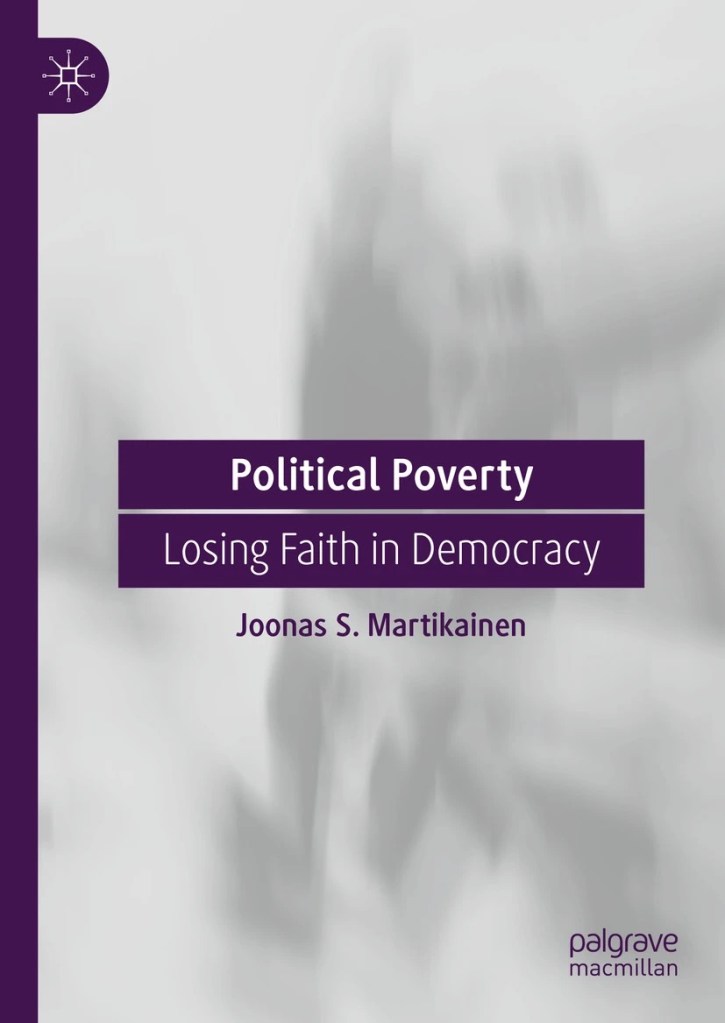
Fresh off the press is a new book by Dr. Joonas Martikainen, who is postdoc in the Agency as Experience and Capacity project.
The monograph, ‘Political Poverty: Losing Faith in Democracy’, delivers a new account of political agency, participation, and disenfranchisement. Drawing on phenomenology and critical theory, the volume enriches political theory by expanding on the motivational aspect of disengagement, such as on hope and a sense of belonging foster political participation.
Perspectives on Agency and Disadvantage 2025: It’s a wrap!
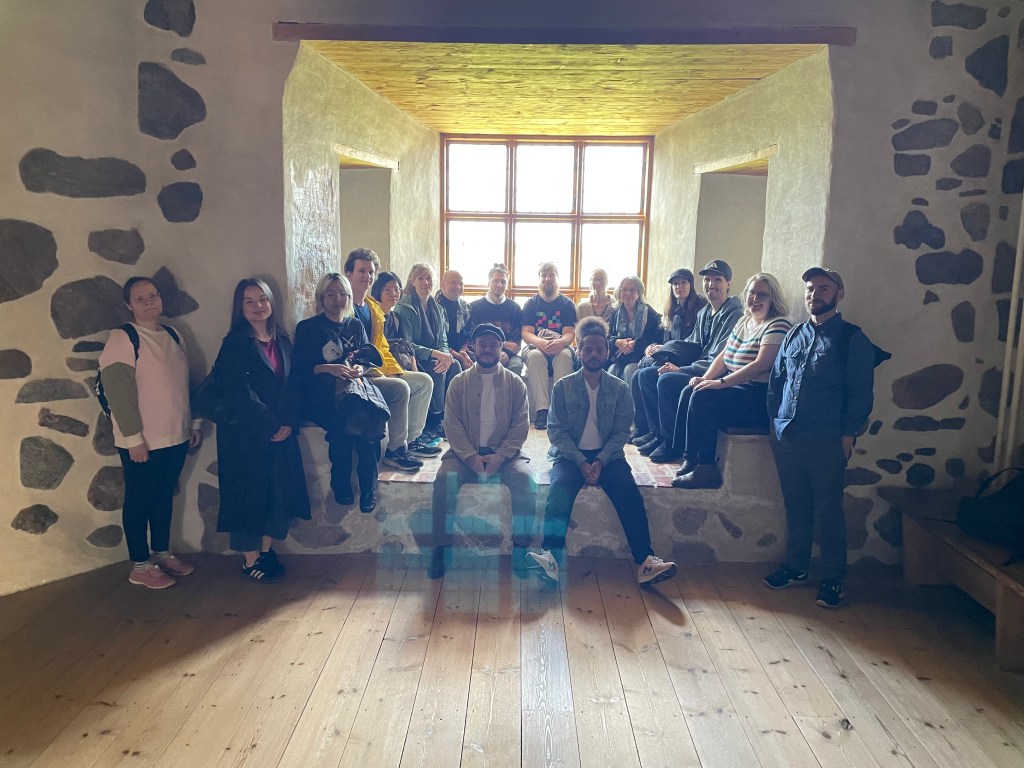
On July 2-3, our group organised the Perspectives on Agency and Disadvantage workshop, bringing together scholars across philosophy, psychology, and law from all continents save for Antarctica.
The event was a tremendous success, if we may say so ourselves! We’d like to thank our speakers and participants for making the event so intellectually stimulating, student assistants for making everything run smoothly, and of course our funders the Kone foundation for making it all possible.
We plan on organising further events in the years to come — stay tuned!
 Polaris Koi